

8 x 8 = 64 SF x 2 (sides)= 128 SF
Total = 448 SF
448SF ÷ .89 SF/CMU = 503.4 or 504 total FB block
Or, you can multiply the square footage of the building times the number of block per square foot (1.125 CMU/SF).
448 SF x 1.125 CMU/SF = 504 CMU
If you were planning a modular building, you would use the square foot method for quicker estimating, but now there is another step you need to know - the DUPLICATING FACTOR. This means that every course will have a half block at each corner. For example, you estimated 504 FB for this building. To estimate the FB accurately, you would deduct two FB/course or multiply 12 courses x .5 (half block HB) x four corners = 24 FB. Then deduct the 24 FB from the total FB as shown in the following formula:
12 courses x .5 x 4 corners = 24 FB
504 FB -24 FB = 480 FB
When you estimate CMUs, usually the window and door openings are designed to be modular and the window and doorframes are of the same mode. If the design is NOT modular, you can expect a lot of cutting time. When you estimate for openings, just calculate the area of the opening, then subtract the area of the opening(s) from the overall area of the wall or building to get the net area. Then multiply the number of CMU per square foot by the net area.
Builders have found that it takes about 38 cubic feet of raw materials to make 1 cubic yard of mortar. Therefore, you can use "rule 38" for calculating the raw material needed to mix 1 cubic yard of mortar without having to do a great deal of paper work. However, this rule does not accurately calculate the required raw materials for large masonry construction jobs. For larger jobs, use the absolute volume or weight formula. In most cases, though, and particularly in advanced base construction, you may use "rule 38" to make a quick estimate of the quantities of raw materials required.
Here is how you use "rule 38" for calculating mortar: take the rule number and divide it by the sum of the quantity figures specified in the mix. For example, let's assume that the building specification calls for a 1:3 mix for mortar,
1 + 3 = 4. Since
38 ÷ 4
= 9 1/2,
you need 9 1/2 sacks, or 9 1/2 cubic feet, of cement. To calculate the amount of fine aggregate (sand), you multiply 9 1/2 by 3. The product (28 1/2 cubic feet) is the amount of sand you need to mix 1 cubic yard of mortar using a 1:3 mix. The sum of the two required quantities should always equal 38. This is how you can check whether you are using the correct amounts. In the previous example, 9 1/2 sacks of cement plus 28 1/2 cubic feet of sand equal 38.
In table 4-3, it takes 8.5 cubic feet (CF) of mortar to lay 100 SF of 8" x 8" x 16" block. In the previous example, you estimated the building at 480 SF of wall area. To calculate the amount of mortar to lay the CMU, first convert the 480 SF to units. See the following formula:
480 sf ÷ 100 sf = 4.8 units
then multiply the units by the number of cubic feet of mortar;
4.8 units x 8.5 cf = 40.8 cf of mortar
To calculate the ingredients needed to make 40.80 CF of mortar with a 1:1/4:3 mix, the 1/4 being hydrated lime, first calculate the amount of cement using rule 38. Remember the formula: 9 1/2 sacks of cement (94 lb/sk) per cubic yard.
Use the following formula: First, convert cubic feet of mortar to cubic yards, 40.8 cf ÷ 27 cf/cd = 1.51 cubic yard.
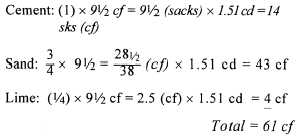
Let's briefly cover the mixing time it will take to mix mortar. A typical mortar mixer has a capacity of mixing 4 to 7 cubic feet per batch, and each batch must be mixed for a minimum of 3 minutes. In the most recent example, we calculated a total of 61 cubic feet of raw materials needed to construct this building. Now just divide the number of cubic feet per batch by the total number of cubic feet of raw materials, then
Continue Reading