

Learning Objective: Describe the basic principles of electrical and magnetic theory. Identify the materials, the devices, and the different types of electrical circuits. Determine electrical measurements using Ohm's law.
The basic principles of automotive electricity are the essential knowledge required by the mechanic to understand the operation of all-automotive electrical systems and components. Unless you have a clear understanding of these fundamental principles, you will find it difficult to service the various electrical components and systems encountered in the Naval Construction Force (NCF). This understanding will enable you to make sound decisions in the troubleshooting process of all electrical systems.
Learning Objective: State the basic principles of electricity, the theory of electricity, and the composition of electricity and matter.
All activity that takes place in any type of electrical circuit depends on the behavior of tiny electrical charges, called electrons. To understand the behavior of electrons, we must investigate the composition of matter. The electron is one of the basic electrical components of all matter.
All matter, regardless of state (solids, liquids, and gases), is made up of tiny particles, known as atoms. Atoms combine in small groups of two or more to form molecules; however, when atoms are divided, smaller particles are created. These particles have positive or negative electrical charges.
There are over 100 different basic materials in the universe. These basic materials are called elements. Iron is one element; copper, aluminum, oxygen, hydrogen, and mercury are examples of elements. The basic particles that make up all the elements, and thus the entire universe, are called protons, electrons, and neutrons. A proton is the basic particle having a single positive charge; therefore, a group ofprotons produces a positive electrical charge. An electron is the basic particle having a single negative charge; therefore, a group of electrons produces a negative electrical charge. A neutron is the basic particle having no charge; therefore, a group of neutrons would have no charge.
The construction of atoms of the various elements can be examined starting with the simplest of all - hydrogen. The atom of hydrogen consists of one proton, around which is circling one electron (fig. 1-1). There is an attraction between the two particles, because negative and positive electrical charges always attract each other. Opposing the attraction between the two particles, and thus preventing the
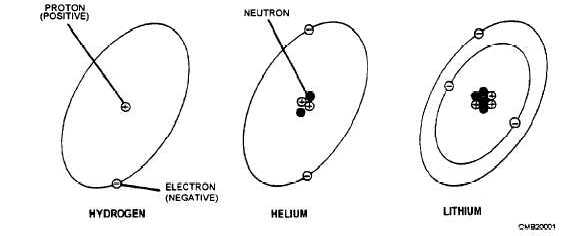
Figure 1-1. - Composition of matter.
Continue Reading